Your cart is currently empty!
Day: April 30, 2022
-

Time To upgrade Your Air Conditioning In Melbourne?
Noisy air conditioners and their effect on our daily life
In the hotter months of summer, an air conditioner in Melbourne might be the best blessing that one could wish for, as it plays a critical role in our comfort and is an inevitable part of our everyday life whether we like it or not. But how can you know when it’s time to replace your air conditioner?
Air conditioners have made our lives more comfortable and convenient, but when should you consider upgrading your existing system?Consider working in hot weather with simply a fan, which does not actually cool the air but only makes it feel cooler by moving around. It only makes life more difficult and miserable. Air conditioners are a godsend in such conditions, but what if the air conditioner makes your life more difficult by making it impossible to sleep, work, or accomplish daily tasks?
It is typical for an air conditioner to make some noise. It’s a good sign that it’s working. Whereas air conditioners generate a bothersome amount of noise, leaving you with little choice but to shout or play television/music as if your home is a theatre, which is later followed by headaches and a slew of other concerning health conditions.
No matter how old your air conditioner is, any noise it makes can be irritating. If your air conditioner is making an unusual noise, it could be a sign of trouble. Instead of endangering yourself or your system by rummaging around inside the unit, be cautious and have it inspected by an expert. When investing in air conditioning systems, one must consider noise along with other important elements such as capacity, efficiency, and cost so that when in use, one feels grateful for what s/he has purchased.
Following are the different types of noises/sounds an Air Conditioner makes:
Rattling:
A rattle is caused by a loose bolt, fastener, screw, or any other small part that has fallen into the air conditioner’s vents. Instead of a loose element, it could be caused by a compressor or another more serious problem. If you suspect this, show it to a qualified technician.
Grinding:
Grinding usually signals a problem with the fan motors; the sound is similar to rubbing or scraping. The noise could have been caused by a worn bearing, a damaged or a loose belt.
Popping:
When your air conditioner kicks on after a while, a popping noise may occur from the air conditioner’s air ducts. This usually indicates a problem with the ductwork rather than a problem with the central unit of your air conditioner.
Hissing:
Hissing is a form of noise produced by your ductwork, so have one of our trained specialists take a closer look. He can locate the source of the noise and notify you if there is a major problem.

The effects of a noisy air conditioner!
Headaches/ Migraines:
If you already suffer from migraines, constant screaming sounds from air conditioners can aggravate your condition. As they are sensitive to light and triggering stimuli, those suffering from these excruciating headaches want a calm, dark, and comfortable environment to relax. In such circumstances, if their split air conditioner system is inadequate and does not cooperate by constantly generating unpleasant noises, the situation will only deteriorate, and the AC will be the biggest adversary at that time. Work at home:
Since the epidemic, many people have begun to work from home, or, in the case of small firms, owners have little choice but to work from home. One can only work in a pleasant, quiet setting in order to focus on their jobs, plan better, take client phone calls, attend meetings, and so on. Working in hot, sticky weather is impossible, but working next to a noisy air conditioner is even more difficult. In such instances, one should seriously consider purchasing a smooth-running air conditioner rather than one that sounds like a jet engine flying.

Infants sleeping:
It is believed that putting a child to sleep is one of the most difficult undertakings ever. Imagine putting your child to bed for 45 minutes to an hour, only to have him or she awaken due to a noisy air conditioner, which you believe was installed as a luxury for you and your family. Of course, in this hot heat, this is the last thing you want to happen.
Observing TV shows/movies:
Are you planning a movie night with your buddies at your house? Do not overlook the fact that a loud air conditioner in your living room can ruin your fully-planned fun night. Because the noise of the air conditioner is loud enough, the voices of TV characters are not heard, and you may not even understand what your friends are saying.
A good night’s sleep:
Coming home after a long day at work or simply attempting to sleep after a long day is all that one want. But, once our air conditioner starts up so loudly that it disturbs our sleep, there is no turning back. Once you’ve been disturbed, you won’t be able to get a good night’s sleep, resulting in lethargy and migraines, all because of your air conditioner.
Peace among Neighbors:
A noble person would never wish to endanger someone else’s serenity for the sake of their own. Apartments/buildings are growing more compact and close together as the world grows more interconnected. The size of our blocks is shrinking, bringing us closer to our neighbors. The noise from your air conditioner unit causes a commotion throughout the neighborhood. As a result, a well-functioning air conditioner should be considered.
<span data-preserver-spaces="true">Beyond Heating and Cooling at your service</span>
Noisy air conditioners may wreak havoc on both your physical and mental wellbeing. As a result, when purchasing an air conditioner, take into account all available precautions so that you do not come to regret it later.
Beyond Heating and Cooling Melbourne experts can assist you in all air conditioning systems installation and repairs depending on the size and area of your room.
The post Time To upgrade Your Air Conditioning In Melbourne? appeared first on Write Buff.
The post Time To upgrade Your Air Conditioning In Melbourne? appeared first on https://gqcentral.co.uk
-

How Metal Detectors Work Explained in Plain English
How Metal Detectors Work Explained in Plain English
How Metal Detectors Work Explained in Plain English: He activated his metal detector in accordance with the manufacturer’s instructions. After testing his detector on a few surface targets, he now begins seeking hidden coins and wealth (coins).
Take note of the “red” signal pattern sent by the metal detector’s coil into the ground. As long as the signal penetrating the earth does not come into contact with metal, there is no auditory signal, no flashing light, no vibration, and nothing happens.
When the metal detector’s search pattern comes into contact with metal items, in this case, shallow and deep coins, the delivered signal is disturbed, and the metal detector warns the detector user (you) with an auditory signal, typically an audible tone. Flashing or strobing lights are occasionally used in conjunction with the audio signal.
Isn’t it straightforward?
Detailed explanation
You do not need to understand the scientific concepts of metal detecting to operate a detector.
You can find gold nuggets, coins, rings, jewelry, stashes, and other valuables even if you don’t understand how a detector works. However, understanding how metal detectors work is critical if you want to understand why your detector just made that peculiar noise and why it reacts to metals and minerals the way it does.
Assume you’re out in the field looking for something and you get a detector signal. You delve a foot into the ground and come up empty-handed. You dig another foot deeper into the pit, but you’re still empty-handed.
Maybe you dig five or six feet more before giving up. Your signal, on the other hand, remained steady throughout the excavation! Where did it all go wrong? Was it your fault or the detector’s fault? Was there a specific goal in mind? Yes, there was a target, though it wasn’t necessarily made of metal. The reaction could have been produced by a change in mineral composition.
Assume you’re looking for a small iron jug filled with gold coins. You’re aware that this iron kettle was abandoned in a field beneath a massive flat rock that had been piled on top of it.
Unfortunately, this field is littered with at least a thousand massive, weighty flat stones. The soil is heavily mineralized, and some of the larger rocks have a significant concentration of iron minerals as well. Knowing how your detector works and the many minerals that can be recognized will save you a lot of trouble in situations like this.
In the first case, you will not dig at all or will only dig about a foot before realizing that there is no metallic target in the dirt. If you are inexperienced with iron minerals and their implications for metal detecting, you will most likely not find the iron pot until you have dug beneath every rock in the field.
Modern and general-purpose metal detectors strive to provide simple theoretical explanations while merely describing the detector’s basic operating characteristics.
This essay was not meant to be a theoretical study, but rather a manual for metal detector users to use at home, in the field, and in the classroom to help them comprehend the fundamental ideas of their equipment. These are not difficult ideas to grasp.
When you begin to research mineralization, target identification, field applications, and other areas, you will be rewarded for learning this background material. You’ll understand why you’re hearing certain signals based on what your detector tells you. You’ll be able to tell whether the object you find is one you wish to excavate more precisely.
It is simple to use a metal detector accurately and efficiently. It does, however, necessitate considerable investigation, deliberation, and practical application.
Radio wave transmission and reception
You’ve probably spent the majority of your life using one side of a metal detector without even realizing it: a standard radio. a standard radio Metal detection is typically accomplished by “emitting” and “receiving” a radio wave signal.
An invisible electromagnetic field spreads throughout the air in all directions as current travels through the transmitting antenna (or another surrounding medium, i.e., air, wood, rock, earth materials, water, etc.).
If this electromagnetic field could be seen, it would resemble a giant three-dimensional doughnut with the transmitting antenna at the center.
Field lines cannot cross one other, according to electromagnetic field theory. As a result, as they travel through the circular antenna, they swarm together, but not on the outside.
This crowding is favorable since the strength (density) of the field lines is precisely what allows metal detection in the vicinity of the metal detector coil. This is the place with the greatest field densification; metal detection occurs here due to two main phenomena: eddy current generation and electromagnetic field distortion.
Metal detection on the beach and in the sea
Because saltwater is electrically conductive, it interferes with the electromagnetic field. Some metal detectors recognize salty saltwater as metal! Detectors that can “ignore” saltwater have been developed by manufacturers.
Depth Sensing
The depth to which an object can be detected is determined by a number of factors. The electromagnetic field generated by the transmitting antenna of the metal detecting coil spreads into the surrounding matrix, causing eddy currents to develop on the surfaces of conductive objects.
Any detectable target that has a significant impact on the field will be detected. The three parameters that determine whether the disturbance is sufficient for detection are the strength of the electromagnetic field, the size of the target, and the surface area.

Strength of the electromagnetic field
How far does the electromagnetic field radiated into the surrounding matrix?
To infinity, theoretically, but you can be sure it will be frail when it arrives! Just a few feet distant from the metal detector coil, the field is significantly weaker.
Attenuation (absorption by the soil, matrix, materials, etc.) and distance are two factors that reduce field strength. When these factors are taken into account, a detector at a distance of six feet may have thousands of times fewer detection capabilities than a detector at a distance of one foot, explaining why detectors’ depth detecting capability is limited.
Some elements, such as iron mineralization and wet salt, have a restricted ability to detect at depth because the coupling is impeded when an electromagnetic field tries to penetrate.
Target Dimensions
Targets can be identified more precisely and thoroughly based only on their size. Eddy currents are more prevalent in larger targets, making them easier to detect. An object with double the surface area of another will provide a detection signal that is twice as intense as the smaller object. However, it will not always be recognized twice as far away.
For the same reason, the larger target at a greater distance from the bottom of the metal detector coil will produce the same amplitude signal as the smaller target. Size is also important in target discrimination.
Each detected object has its own pattern, as shown above, with the detection pattern for the jar with the coins on top being more thorough and stretching farther from the bottom of the metal detector coil.
Metal detectors are typically used as area detectors. They do not function as metal detectors (mass detectors). The greater the surface area of a metal target “looking” at the bottom of the metal detector coil, the better the target detection.
The majority of detection methods have little to do with the target’s actual volume or mass. Examine it for yourself. Set the threshold for your detector and turn it on. Bring a large coin up to the coil of the metal detector with your hand, such that the front of the coin is “looking” at the bottom of the coil. Take note of the initial detection distance of the coin, for example, eight inches.
Return the coin and spin it ninety degrees so that the edge of the coin “looks” at the bottom of the metal detector’s coil. As you pull the coin closer to the coil of the metal detector, you will notice that it cannot be detected at eight inches.
It will most likely be discovered at a size of four inches or less. Another example of surface detection is determining the distance at which a single coin may be detected.
Then, place a large number of coins on the back of the test coin and see how far this stack of coins can be detected. The stack is only visible from a little greater distance, demonstrating that increasing the metal volume has little effect on the detection range.
The article was written by ahmarticles.com
The post How Metal Detectors Work Explained in Plain English appeared first on https://gqcentral.co.uk
-

Staying Safe on the Streets of our Cities
Best Tips for Staying Safe on the Streets!
Staying safe on the streets of our towns and cities has become much harder than it used to be! And don’t be misled, it’s not just the big cities either! Some people even feel safer walking the streets of a major city than those of a quiet and dark country town!
Lately, there has been increased public concern over safety on the streets. Such events have triggered dramatic scenes, protests and awareness, and highly charged debate in the news and social media. We have collected and bundled together some simple strategies that anyone can use to help stay safe.Staying Safe on the Streets: Take a Buddy
In what seems the most simple advice, try and walk with a friend or pal each and every time. Ask your significant other, a roommate, or another friend to go with you on any trips to the local shops or cheerfully strolling home from a late-night party, for example.
You are automatically a less strategic target if you’re not alone. And these days, any extra, genuine social interaction that is not via a smartphone or PC is a fantastic way to spend your personal downtime.
Darkness can Create the Opportunity of Surprise
If you happen to unexpectedly find yourself walking alone at night, stay near well-lit places of business and well-lit walkways.
Stay completely away from alleys and any other poorly lit, closed spaces that might allow an attacker the advantage of surprise.
Staying Safe on the Streets: Stay Alert at All Times
When you find yourself walking alone, day or night, it is essential to be alert. Don’t be distracted or aloof around your surroundings, and do not take things for granted.
A distracted person is an easy target. In the same vein as using your phone while driving a car, it is much safer for you to put the phone in your pocket. Surely the world can go without hearing from you or checking your social media for the next ten minutes! If you have your phone open, your eyes, mind, and hands are otherwise engaged, and you won’t be ready for any potential attack.Scan Your Surroundings Like the Terminator!
Your eyes and ears are your most powerful tools, and as you walk, you should be paying attention to what you can see and what you can hear. Taking in the details of your surroundings can help you identify potential problems before you’re in the middle of an unsafe situation. You can also identify exit routes, safe places to duck into, and allies on the street more quickly.
There’s a Right Time for Blaring Music

Far be it for me to tell you that you shouldn’t enjoy your Bluetooth headphones and motivational music during a morning or evening walk or run. If you take a gentle, daylight walk along a residential street with traffic, pump up the volume and get into the music! However, if you’ve just left a late-night party and are walking home through seemingly quiet streets and not much traffic, let’s keep the earbuds in your pockets or bag! Just make sure it is safe before you choose to get lost in your music.
Staying Safe on the Streets: Car Safety
Your hands are so important and should be free, so you can defend yourself or be prepared for immediate action like unlocking your car. For example, before you leave the mall, grab your car keys out of your bag. Then, keep them ready in hand as you walk through the parking lot to your car. This way, you are prepared to get in your vehicle straight away, instead of standing around like a sitting duck while trying to find your keys!
The number one rule here is to lock your car immediately after sitting down. So many people have been attacked from behind after an assailant jumped in through the back doors.
Staying Safe on the Streets: Ooze Confidence and Purpose
On any occasion you find yourself walking alone, walk with purpose and project confidence. Be sure to hold your chin up, keep your eyes forward and stride out at a fast speed.
Similar to the sometimes brutal animal world, attackers are more likely to victimize someone who looks lost or timid.
If you are unsure where you’re going, FAKE IT AND ACT LIKE YOU KNOW. Don’t stop moving and act as if nothing is wrong. If you feel hopelessly lost and need to look up directions, or reset, don’t make it obvious by looking confused and disorientated. An intelligent attacker will pick up on it and use this to their advantage, possibly offering you a ride or other assistance.
Trust your gut and decline if a stranger seems too insistent to help you.What’s Open and can Get You Out of Danger?
Instead of standing still and trying to work out where you are, look for and enter any open and engaged space such as a strip mall, petrol station, or pizza shop! It is incredibly unlikely that a would-be attacker will follow you inside. A safe and populated place also gives you a perfect opportunity to call a friend or a cab. Make sure you stay inside until they arrive.
If A Threat Confronts You
It may seem like a good idea to tell a robber that you have no money in the hope they might leave you alone, but this technique may backfire. It is far better to give up a few dollars than your life!
 The stolen money can be replaced. You or a loved one can not. Carry a little cash separate from your other funds in an accessible place.
If someone demands your property and displays or implies that they have a weapon, please don’t resist.Don’t Be Afraid to be Vocal and Loud!
If someone tries to grab you, make a scene. Scream, kick, fight, or do what you can to get away and attract attention.
If you feel that someone is following you and making unwanted verbal contact, a great strategy is to create a loud and attention-grabbing scene that turns the discomfort on them, ultimately causing them to leave. Strange noises and disturbances may be significant if it is nighttime in a residential neighborhood. It would help if you got people looking out their windows or opening doors to see what’s up.
Stay in a well-lit area, so it’s easy for people to see and help you. Get under the sensor light if they have one, drawing attention to yourself. Don’t be afraid to tear up to somebody’s deck if you have to.What if No One Else is Around?
On occasion, you may find yourself somewhere with no one else around. It is best to not verbally engage the threat unless you feel in danger or if they make a sudden move to come upon you.
If they make a move on you, it’s time to increase the volume! You must scream and yell so that people in the area might hear you and look out their windows. Yell with a loud and clear “GO AWAY!” or “NO!”
Be strong and forthright. Commit to your inner power and try your best not to waver or sound unsure. A time such as this is NOT the time to be polite and meek. Yell, scream and throw in a heap of f-bombs if you need to – noise is your friend and will work as a car alarm screaming out into the silence! Assailants target people they perceive as easy mark who won’t put up much of a fight. Making a scene and being loud tells them this attack won’t be easy, and you aren’t going to go quietly.Staying Safe on the Streets: Self Defense Options
The products we will discuss are two of the best, readily available, and straightforward to use self-defense options. They are both safe for the user and legal to carry in most states.
Carrying a knife or gun is helpful, but you must be fully trained and competent to use these weapons. Training takes a lot of time and may not even be legal to carry in your state. Knives and gins can also be taken from you or even turned against you by a better-trained attacker. There are better options available as solid day-to-day personal security measures for these reasons.
Pepper Spray is the Number 1 Self-Defense Option for Street Safety!
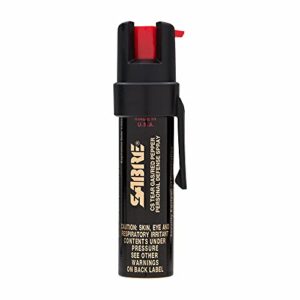 Sabre Pepper Spray is by far the best confidence booster and personal security partner you will find! Pepper spray is relatively easy to find at hardware stores, online department stores, or sporting goods stores. You don’t need overkill for staying safe on the streets; Just a simple handheld unit from a trusted brand will suffice.
For example, the Sabre Advanced Compact Pepper Spray with Clip (pictured) is one of the most highly rated and frequently purchased pepper sprays across Amazon!Like the safety mode on a firearm, most pepper sprays have safe and secure locking to prevent accidental discharging. Several models also have hand straps to help keep them with you and ready to go whenever needed!
Using pepper spray is pretty easy too. You simply point at the target and spray!
When contact with the spray is made, they grab their eyes and scream. That is when you RUN!Kitty Cat Self Defense Keychains
These look cute, like an adorable little kitty cat but think again. It’s closer to a knuckle buster! Once you slip your fingers through it, it makes a great tool and inflicts severe damage. Furthermore, it is much less likely to get wrestled away or turned against you because it is practically fixed to your hand.
Of course, the hope is that your attacker never even gets close enough for you to use one of these options. However, you will certainly feel safer and more confident knowing you have one.Gross Them Out with Your Spit
Yes, you read correctly – spit. In times of Covid and other diseases, people are often more fearful of bodily fluids than a 9mm pistol being pointed at them! You can use your own spit as a self-defense tool if you’re in danger.
Not only have you just done something super unexpected, but it might even gross your attacker out. If you’re lucky, he’s also distracted and furiously trying to wipe the spit out of his nose and eyes. This minor disruption of time, no matter how gross, is your brief window to get away and yell for help. Like the lion that gives up the chase on the gazelle that is too fast, your attacker will most likely give up too and look for an easier target!The post Staying Safe on the Streets of our Cities appeared first on https://gqcentral.co.uk
-

What You Should Know About Partial Dentures
Partial Dentures – Solution for Missing Teeth
After a tooth is lost, dental patients must determine the best technique for tooth replacement. A dental specialist will discuss the advantages and disadvantages of each tooth replacement option, as well as an estimate of the cost after dental insurance coverage is applied. Many people prefer complete or partial dentures since they are inexpensive and frequently covered by insurance.
If the patient does not require full dentures, the dentists can create partial dentures. Many people might learn about suitable tooth replacement choices by researching partial dentures.
What Exactly Are Partial Dentures?
“What is a partial denture?” dental patients may inquire. Partial dentures are recommended by dentists for those who have lost a segment of their teeth due to extractions. Whatever the reason for the person’s tooth loss, the parts could be an effective approach to replace the missing teeth and restore the patient’s smile.
A partial denture or bridge is made by a dentist using a mold of the teeth and gums, and it is attached to the gums with adhesives. A removable partial bridge can be provided by a dental practitioner, or the bridge can be permanently installed. If the partial is removable, the individual will utilize adhesives to glue the components to their gums in regions where the teeth are lacking in order to restore their smile.
Assume the dentist permanently installs a partial or bridge. The bridge is connected to the crowns by the dentist, who makes a crown at either end of the device. In addition, the dentist uses abutments and professional-grade adhesive to secure the rest of the bridge to the gums.
What to Know About Partial Dentures

The teeth on the partial denture will be white and appear natural. Before the extractions, the dentist will try to build a mold of the teeth if possible. A new set of dentures or bridges, on the other hand, can offer the person teeth that are more aesthetically beautiful than their natural teeth.
Partial dentures and bridges may be covered by the individual’s dental insurance. Before scheduling an appointment for dentures, the individual can schedule a consultation for an examination and receive a detailed estimate for tooth replacement services based on the coverage offered by the dental insurance.
With a partial, the client must return to the dentist for an examination to establish whether the partial is still in good condition or whether it needs to be replaced. The dentist will examine the present state of the permanently installed bridge or partial and evaluate whether repairs are necessary.
Why Would Someone Require Partial Dentures?
To replace missing teeth in a row or region, a partial is required. Instead of replacing the teeth one at a time, the dentist might provide a partial or bridge to replace numerous teeth at once and restore the smile. Dentists can discuss the best possibilities for replacing the client’s teeth and provide the person with everything needed for a tooth replacement process.
Advantages of Partial Dentures
First, the partial replaces a segment of teeth all at once, eliminating the need for the user to worry about subsequent humiliating occasions caused by tooth loss. The teeth will appear natural and will remain in place. Because these teeth replacement goods are not considered aesthetic or elective, most people receive at least 80% coverage for them. Teeth replacement can help a person regain the ability to chew and talk properly.
What Kinds of Partial Dentures Are There?
There are two kinds of partials: removable partials and permanent partials. With detachable partials, the patient must rely on adhesives to hold the bridge in place. The adhesives can be recommended by the dentist to reduce the possibility of the appliances falling out of the mouth at inconvenient times. The person does not have to worry about the gadget falling out with permanent partials or bridges. From the middle to the gums, the dentist places a crown on each side of the partial and bones.
How To Choose the Right Partial Dentures

The dentist fashions the portion from a mold of the gums, attempting to mimic the appearance of genuine teeth. Following the completion of the partials’ construction, the dentist can exhibit all available partials as well as digital photos of the result.
Partial dentures are advantageous tooth replacement choices that are perfect for replacing lost tooth portions. After completing many extractions, the dental expert might supply partials. Furthermore, by receiving the partial, the individual can regain their ability to chew and talk appropriately.
The individual can choose between a removable item and a permanent installation with a portion. These alternatives are equally effective as dental implants in replacing teeth. Nonetheless, the gadgets are less expensive than implants or implant surgery. The partial will also appear to be natural teeth, restoring the smile. Dental patients who have lost many teeth can now learn more about partial dentures by scheduling an appointment with their favorite dental professional.
Brought To You By: Garland K. Davis, DDS
The post What You Should Know About Partial Dentures appeared first on https://arquiaca.org
The post What You Should Know About Partial Dentures appeared first on https://wookicentral.com
The post What You Should Know About Partial Dentures appeared first on https://gqcentral.co.uk