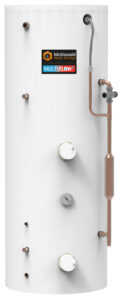
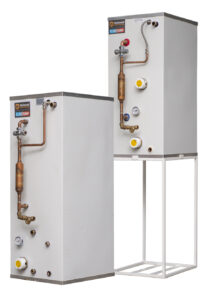
Thermal storage is ideal for combining heat sources to maximise energy efficiency while providing water and space heating. Here are five thermal storage facts that installers should be aware of.
1) A Thermal Store Operates At Mains Pressure
A thermal store is a container that holds and regulates heat until it is required. It differs from a standard hot water cylinder in that the thermal store’s stored water is not delivered immediately to the taps. Heat is transferred from the thermal storage water to the mains or tap water by passing it through a plate heat exchanger. Heat exchangers, particularly flat-plate heat exchangers, may rapidly convey a considerable quantity of heat, allowing householders to take a mains pressure shower or quickly fill a bath.
Thermal storage may have one or more heat exchangers inside coiled pipes or outside flat-plate heat exchangers. A heating element, such as a standard immersion heater, may also be inserted.
Thermal storage can provide room heating and mains pressure hot water, or only hot water.
2) A thermal store can use a variety of fuels.
Thermal stores are built and sized to accept heat from various sources. It might be used to store heat from a wood-fired boiler, a solar thermal system, or a conventional gas or oil boiler. It must be specified when purchasing whether the homeowner intends to add a fuel source in the future.
A solid fuel device burns fuels including wood, wood pellets, and biomass (popular biomass fuels include discarded wheat, straw, nut shells, and other fibrous material). These fuels are frequently poorly quality, inherently unpredictable, and readily available. A thermal storage unit regulates the time lag between when heat is available and when it is needed for conversion into hot water and water heating.
Open vented thermal stores offer the ease and luxury of a pressure system with heat generated by solid fuel appliances and a straightforward and fundamentally safe method of providing high-performance mains pressure hot water.
The energy from the solid fuel appliance passes into the thermal store, supplying water circulating throughout the heating system. This means that the available energy might power the heating circuit, decreasing dependency on fossil-fuel-based boilers and lowering home operating costs.
Connecting wood-burning stoves or other uncontrolled heat sources to an unvented cylinder is impossible. Combining other energy heat sources to provide energy to the heating circuit is challenging, which is one of the distinct advantages of thermal storage.
Solar thermal energy can also be used to heat water through thermal storage. The thermal store uses a high-efficiency solar coil to give the homeowner natural solar energy produced during the day. When solar energy is insufficient to heat the store, it will convert to a conventional boiler as its primary heat source.
Although a sealed system boiler can directly supply the central heating circuit, an additional heating circuit can be coupled from the thermal store. The solar will also provide input.
3) When fuel sources are merged, the full potential of a thermal store is realised.
The full potential of a thermal store is realised when it uses a range of heat inputs.
A high-efficiency solar thermal input during the day could heat the water in the thermal storage.
Assume the property contains a wood burner, usually lit in the evening. In that instance, it might be coupled to a system that raises the water temperature in a thermal store created by solar energy during the day.
A regular boiler or an immersion heater could help with this.
Assume you have access to a low-carbon or renewable energy source. In such a situation, it might be linked to the immersion element to provide heat input to the thermal storage, reducing the demand for the fossil fuel boiler and, as a result, saving running expenses.
4) A thermal store is a fantastic off-grid option.
Off-grid residences with various heat sources, including wind power, are one example of where thermal storage can be a highly creative choice. When other energy sources were insufficient, the thermal storage would use mains electricity as a backup supply. Similarly, a thermal reserve can help reduce reliance on oil or LPG.
5) A thermal storage is simple to install and requires little upkeep.
Thermal storage can be installed practically everywhere in the home as long as the main header storage tank is installed above the radiators. They have no discharge pipes and require almost no maintenance, making them a perfect alternative for flats and retirement communities. Because there is no standing water, there is also no risk of Legionella or contamination.
There are a number of heating systems you can consider for your home, in this post we describe the different choices of Portland heating and cooling systems you may choose for your home, depending on your energy efficiency or budget needs. Depending on where you live, winter can be a drag. In some regions, you may be stuck scraping ice off your car in the morning. You may also have to deal with shorter days, snowy weather, and dicey road conditions. And then there’s the inevitable case of cabin fever. Regardless, of your area, a warm house is necessary to avoid cabin fever and stay warm. But heating an older house can be expensive.
Geothermal Heat Pumps
Because geothermal heat pumps use a liquid in a closed loop in the earth to generate heat, they are highly effective at reducing electricity use. These units also reduce associated emissions. Studies have shown that they reduce emissions by as much as 72 percent. Geothermal heat pumps also produce no carbon monoxide, which is a danger to indoor air quality. A three-ton residential geothermal system can save as much as a ton of carbon dioxide per year. And the installation of 100,000 residential geothermal systems can reduce greenhouse gas emissions by nearly 1.1 million tons of carbon equivalent, or the equivalent of 58700 cars off the highway. That’s a lot of trees!
This high-efficiency geothermal heat pump can also provide a portion of the home’s hot water. It also features a communication-enabled Aurora controls system and variable-speed blower motor. These controls are easy to operate and use, and the geothermal heat pump provides the greatest comfort and energy savings. Another geothermal heat pump model, the York LX Series, provides domestic hot water assistance and can manage up to eight zones.
A geothermal HVAC system uses well water to produce heat. The water enters the home from the well, passes through a vapor-compression process, and then returns its thermal energy back to the ground through the ducts. The heat produced by the geothermal heat pump is then released into the ground and filters through the soil. The energy is returned safely to underground aquifers, reducing the need for supplemental heating.
Because geothermal heat pumps use groundwater, they are an excellent option for homes and businesses in hot climates. In many parts of the country, the temperature of the ground is 45°F (7°C) or higher in winter and 75°F (21°C) in the summer. This makes it the best heating and cooling system available. It’s not only effective but also environmentally friendly, so there’s no need to worry about any pollutants.
Another factor to consider is the COP. It measures how efficient geothermal heat pumps are at converting energy. The COP of geothermal heat pumps are three to four. The COP of fossil fuel furnaces is typically between 78-90 percent. However, geothermal heat pumps can reach 400 percent efficiency. These numbers are based on a year’s average summer temperature of 28 degrees.
Air-Source Heat Pumps
The efficiency of air-source heat pumps is often rated in Seasonal Energy Efficiency Ratio (SEER) or Heating Seasonal Performance Factor (HSPF). Federal minimums exist for these ratings. Oversized heat pumps are inefficient and will increase your energy costs and reduce the unit’s life span. The SEER and HSPF ratings should be chosen for both cooling and heating needs.
The energy savings will depend on the size of the pump and the type of control system you use. However, heat pumps can reduce your electric bill by up to 50 percent. You should consult an energy advisor or a contractor to find out whether heat pumps are the most cost-effective option for your home. The savings you achieve will depend on the cost of electricity and fuel, as well as your local climate.
There are two main types of heat pumps: ground-source and air-water. The latter is less common in Canada. Air-water heat pumps provide thermal energy for a hydronic distribution system, which includes low-temperature radiators, radiant floors, and fan-coil units. Air-water heat pumps provide thermal energy to the hydronic system but reject the thermal energy to outdoor air. Hence, air-source heat pumps are the most energy-efficient heating and cooling system.
The simplest form of an air-source heat pump is the reverse of a traditional heating and cooling system. Instead of pulling heat from the surrounding air, they use the heat-exchange properties of the refrigerant to extract and then release the heat. The heat-exchange process is a cycle that reverses during the summer. In winter, the heat pump extracts heat from indoor air and rejects it outside.
The ductless version has a supplementary unit that complements the operation of the air-source heat pump. This type of system can be used in new installations as well as existing ones. The supplemental unit is located inside the indoor unit. These systems are more energy-efficient and can be installed in smaller homes. These systems are also the quietest systems. They are also the most environmentally-friendly heating and cooling system available.
Ground-source Heat Pumps
A ground-source heat pump is a system that uses the ground to supply heat in the winter and rejects it during the summer. It uses a series of tubes, called a loop, buried in the ground. These tubes are designed to provide constant heat to the building without causing extreme temperature fluctuations. Ground-source heat pumps are also very efficient in summer and can be used for domestic hot water.
The most important advantage of a ground-source heat pump is its efficiency. They are far more energy-efficient than other systems because they use less energy to move heat than they do to create it. By comparison, fossil-fuel-powered heating systems are typically only 80 to 90 percent efficient, wasting between 10 and 20 percent of the dollar they spend on electricity. By contrast, ground-source heat pumps can be as much as 350-500% efficient, providing three to five units of heat per unit of electricity.
The most energy-efficient heating and cooling system are the ground-source heat pump. These systems take advantage of the earth’s constant temperature to provide comfortable, whisper-quiet comfort. Because they are more efficient than air-conditioning systems, they are also easier to install, especially in new construction. In addition, ground-source heat pumps take up less space than traditional furnaces and boilers.
Because they use geothermal energy, they are available all over the world. The Nordic countries, for example, are the world leaders in geothermal home heating and cooling. One in five Swedish homes is heated by a ground-source heat pump, primarily due to the fact that the earth is at a constant temperature below the freezing line. So, geothermal heat pumps are ideal for homes in cold climates.
An air-source system is more common than a ground-source one. Its variable-capacity compressors and heat exchanger designs help it adapt to cold climates while maintaining high efficiencies in warm climates. Its SEER values are higher than those of their air-source counterparts, with some systems achieving up to 42 SEER. Another advantage of air-source heat pumps is their independence from the outdoor temperature.
Boilers
Boilers are the most energy-efficient heating and cooling system available. They use water as the energy carrier, so they require less energy than other systems. Water is heated at the boiler and then pumped through water lines to various heating elements. As it cools, it returns to the boiler. That way, your home stays warm all year round. A boiler is the most energy-efficient heating and cooling system, but it’s not the only option.
A boiler is a major part of any heating and cooling system, and it’s an essential part of a home’s heating and cooling system. Most boilers operate at 80 percent efficiency or higher, though there are several other options. Most boilers are expensive, but they do have a long lifespan. The federal government requires new boilers to be at least eighty percent efficient. Most boilers last between fifteen and 30 years, and they may be more expensive than a typical home heating system.
A boiler’s size is just as important as its efficiency. An undersized boiler will not work effectively, while an oversized boiler will cost more to run. A heating and cooling professional can help you choose a boiler with the proper size based on the type of home and other factors. Natural gas boilers are the most energy-efficient heating, and cooling system, but they aren’t available everywhere. Those living on the ends of a gas pipeline may have to pay higher fuel bills. Propane is more expensive than natural gas but is widely available across the U.S.
A boiler is an important part of any heating and cooling system. A boiler uses a pump to move the heated water through the home. They are a great option for homes in colder climates. In addition, they also provide hot water for laundry. Another reason that a boiler is the most energy-efficient heating and cooling system and is so versatile is that you can use it to heat your home. The boiler is often referred to as a “combo” or “combi”boiler because it has a number of uses.
The path of the HVAC as we currently know it, as well as modern Boise heating and cooling systems in local homes, began with the Chinese cooling system. We then learn about Carrier air conditioner development and how it benefits your local HVAC company. Last but not least, we discover motor fans. Let’s take a look at some of the most significant inventions of our time. We’ll go over the evolution of the HVAC system as a whole here. Continue reading to learn more about these items.
The Invention of Motorized Fans
HVAC’s voyage into the contemporary era began with the Chinese, who invented the fan. They observed that flowing air across the skin provided temporary cooling. The Chinese were fast to develop a system to imitate this effect, which later became the foundation for modern air conditioning fans. The Chinese began to perfect their fans in the early twentieth century. They were the first to use the technology in commercial HVAC systems.
While HVAC existed in the 1700s, it wasn’t until the mid-1800s that the general concept of centralized HVAC systems was developed. HVAC technology has been evolving for decades, and new advancements are continuously being introduced. HVAC has existed in various forms throughout human civilization’s history. This past, however, is simply the beginning of its voyage into the modern world. Here are some of the most significant turning points in HVAC history.
Dr. John Gorrie utilized his innovation to cool the Missouri State Building in 1904. It was the first public air conditioning system to be placed in a residence, and it was soon used in public theaters, offices, and factories. H.H. Schultz and J.Q. Sherman designed a window sill unit while commercial HVAC was still too expensive for domestic use. By the 1960s, it had become the most common type of HVAC in homes.
HVAC professionals must have a wide range of abilities. They must be problem solvers, spatially aware, and good with their hands in addition to being skilled in installing and repairing air conditioners and furnaces. HVAC is a continually growing field, and the skills you learn can help you become a very successful HVAC specialist. You can boost your salary by furthering your education, and you can even start your own business. There are various advantages to hiring an HVAC expert.
Carrier’s Air Conditioner
Willis Carrier began the Carrier Engineering Corporation with only $35,000 in cash; today, the company has grown into a global producer of air-treatment equipment and is a subsidiary of United Technologies, a climate-control corporation with a $53 billion net worth. He built the first centrifugal refrigeration compressor for air conditioners in 1921, which made them much smaller and safer than their predecessors. In 1928, this development made air cooling widely available to householders.
Willis Carrier’s idea was originally used to cool a Brooklyn printing house. The air conditioner regulated the temperature and humidity, which aided the printing process. The machines also kept the paper from curling and the ink from smearing. Carrier and his friends established the Carrier Air Conditioning Company of America in 1922, and soon after, the first private-use air conditioner was installed in a movie theater.
Air conditioning equipment was large and expensive in the beginning. They were also hazardous to use because they relied on ammonia, which was highly toxic and destructive. Despite this, the early air conditioners were a popular summer film. In fact, it was so popular that it spawned a summer blockbuster. Commercial buildings eventually fitted air conditioning units. By the late 1960s, barely 10% of American households did not have air conditioning, as the technology expanded from the business world to the home. By 2007, the figure had grown to 86%.
Willis Haviland Carrier invented the first air conditioning machine in 1902. The system used ventilation and air circulation to adjust the temperature and humidity. The Carrier Engineering Corporation was formed in 1915, and the corporation was founded in New York. It was a ground-breaking invention that transformed America. It’s astonishing how much has changed in a hundred years. There are now more options for cooling off than ever before.
Chinese Cooling Systems
In Shenzhen, China, a centralized air-conditioning system is being built. The District Cooling System, or DCS, will provide 400,000 Refrigeration Tons of chilled air per year to a 19 million square meter area. It is expected to save 130 million kilowatt-hours per year. Three of the ten cooling stations have already been built, with seven more on the way.
One of the most remarkable characteristics of China is the evolution of AC cooling systems. It is said that because there was no refrigeration in the country in the past, the inhabitants remained warm or cool all year. Technology has existed for thousands of years. Indeed, cavemen understood that living underground would keep them secure from predators while also keeping them cooler. Cavemen, in fact, invented geothermal-cooled dwellings.
Local Boise HVAC Services
A heating and cooling unit is a necessary device for homeowners in modern homes such as Boise since its functions are in need all year round for many modern homes. As a result, HVAC servicing or repair is required to maintain this equipment working properly for your family. Even in mild winters, your furnace must be operational in order to keep your family warm. And your hot water heater to heat the water you use on a regular basis. During the summer, your cooling system will be under higher demand to chill your home and distribute cool air throughout it.
Clogged and unclean air filters, for example, might cause HVAC equipment to spend more energy than necessary. To avoid this, residents should change their air filters on a regular basis, preferably at least once a month during the months when HVAC systems are widely used (Summer and Winter). If your HVAC units are not working efficiently, even though the air filters are new, you should get Boise HVAC specialists to evaluate and repair them.
Furnace vs heat pump. What are the advantages of a heat pump when compared with a furnace? It is clear that a heat pump emits less carbon dioxide per unit of heat produced, but the cost for the initial installation is higher. Is the furnace which uses the fossil which is fuel natural gas really so bad? Does the heat pump really provide cleaner heating? And, why do you say “reducing carbon emissions can’t wait, or it’ll be too late.”
What Goes on in a Heat Pump?
It is not always clear to people who are not familiar with the science and history of heat pumps that they were developed from day 1 to reduce the emission of carbon dioxide. It is principally carbon emissions that are proven to be heating up our planet. This will have dire consequences for mankind if it is allowed to continue. A heat pump is an appliance that transfers the heat from one area from one source to another. In other words, it transfers heat from a cooler part of space to a warmer part of space.
Even a Heat Pump is Not Perfect for Our Planet
A heat pump does not currently produce zero carbon emissions because it needs electricity to run the pump. However, as globally all nations reduce their use of fossil fuels in old power stations and electricity generation moves on to renewable sources heat pumps will become “cleaner”. That’s because the power used by heat pumps, running on electricity from the grid, the carbon emissions they reduce will also go down as decarbonization progresses. That’s a point often missed in the Furnace Vs Heat Pump debate.
Heat Pump Was Though to be an “Impossible Invention” When First Sold
The invention of the heat pump was amazing to everyone when the concept was first explained in the 1960s because people said that you cannot take something cold, and pull warmth out of it. “How would you use that heat to make another cold thing warm-up?”; they asked. But it was shown to be perfectly possible to do in a heat pump. During heat pumping that “warmed up thing” becomes warmer than the original cold thing, and can be used to heat homes, offices etc! When people started to use the heat pump to heat up their homes it was not believed that this could be possible. They said entropy is an inviolable principle of nature! Everything in the universe gets cooler and heat dissipates everywhere all the time. The entire universe has been running down since it was created and one day everything will turn cold. As that continues, all reactions, eons into the future will slow down to a stop. But, they forgot that science is clever and can (in this small way) for a while (by expending energy in a particular way) reverse an inviolable Law of Nature, namely “entropy”.
However, we all have refrigerators and inside their systems, they have been quietly reversing “entropy” by pumping heat out of the food in the fridge. The pumped heat warms up the radiator wires on the back of every fridge. Yes, a fridge is a form of heat pump, but nobody quite thought of it that way.
In fact, if the original inventors had not thought outside the box about fridges, we wouldn’t even be having a Furnace Vs Heat Pump debate, because heat pumping would never have been discovered.
Furnaces Which Burn Natural Gas are Damaging Our World – The Truth
The great majority of furnaces in the US and Europe burn natural gas. The name “natural gas” is to a degree deceptive because most people assume that what is natural is also “green” and in harmony with nature. However, natural gas is just as much a fossil fuel as coal and oil, which once burnt releases fresh new carbon into the atmosphere. Carbon dioxide from burning natural gas is almost as damaging as that from coal, or oil, and that’s highly relevant to the Furnace Vs Heat Pump debate.
Thankfully though, natural gas is both:
warms the globe less than coal and oil from the point of view of the fact that releasing each calorie of heat causes less carbon dioxide when using natural gas, and hence for the same heat output, less carbon is emitted
the result ofburning it releases far fewer impurities than are emitted from within the coal or oil, when those are burnt. This means that there is far less air pollution from burning natural gas then when using coal or oil.
Furnaces are OK – Except “Not Renewable” Powered By Natural Gas and Oil
Furnaces are damaging simply because the energy source is not renewable. If a renewable replacement was available for natural gas the furnace in your home could be replaced by another when it is worn out, and there would be no need for a heat pump instead. If that was true I doubt we would even be having this Furnace Vs Heat Pump debate. People have been talking for the last 20 years or so of hydrogen as the new fuel and there are plans afoot in Europe to construct a completely new gas grid distribution for hydrogen. In other countries, including the UK the idea is to add hydrogen in with natural gas, and “renewable natural gas” (natural gas made through the use of anaerobic digestion of organic waste – for example from sewage sludge).
Converting Gas Grids to Hydrogen/ Renewables Can’t Happen Any Day Soon
Unfortunately, in all nations, the conversion of gas grid distribution systems to renewable gases and especially hydrogen will take at least 20 years to progress. At the moment solar and wind turbines are used to make renewable electricity. Once enough of those have been built to replace all fossil fuel used to generate electricity for day to day grid supply, a huge quantity of yet more renewable energy will be needed for heating and transport use. In fact, three or more times more solar and wind sources will need to be built to decarbonize heating, transport, and industry and used to electrolyze water and make hydrogen gas to replace natural gas for heating our living spaces and powering all transport.
While the more permanent renewable solution of hydrogen gas grid distribution is developed, heat pumps plus much-improved heat insulation will tide us over. It is often said that hydrogen is “the future for energy”, and so it most probably is, but it isn’t here yet! Hydrogen is a much better option than batteries as a 24/7 always available power source. Batteries need rare elements in their construction and present major problems for the environment when disposed of.
Furnace vs Heat Pump – How Does a Heat Pump Work?
There are 3 main components to a heat pump:
a low-grade heat source, such as a fan to collect the ambient air around a building, or a pump and a loop of pipe buried in the ground in the garden. Swimming pools in the home have also been used.
a compressor and condenser system to do the heat pumping
a fan or a water pump to convey the pumped heat into the property. If so designed, this system can also cool the property in summer.
It is a closed-loop system. The most common type is an air heat pump. The air heat pump uses a fan to collect low-grade heat from the ambient air outside the property. A compressor is used in a condenser pump system similar to the workings of a fridge in reverse and releases the heat during the process which emanates as very warm (not hot) water. Just don’t get the idea anything particularly high-tech is going on in a heat pump! It is exactly the same principle as a refrigerator. It just works in reverse. The main component is a compressor to compress the gas in the condensing system that will be the energy source to power the system. The heat exchanger is normally a system of warm water pipes laid beneath the floors of the property. An alternative is to provide heat as hot air which flows out via fans into the rooms to be heated. For more information on heat pumps visit: https://sites.google.com/site/groundsourceheatpumpuk/
Air-Source and Ground-Source Heat Pumps
The other basic heat pump in the market is often called a fluid heat exchanger usually fed by water from a ground heat source (Ground Source heat pump). It acts in exactly the same way as an air heat pump. The fluid heat pump will extract the heat from an intermediate fluid, typically water which has passed for example, through buried pipes in the ground, outside the property. This fluid will become cooled as it flows through the heat exchanger, the warmth will then be emitted to heat the property. The cooled water will flow back through the loop into the ground and its temperature will be raised again in a repeating cycle. It is the same principle as for the air heat pump except rather than from the air around the building, the fluid heat pump extracts warmth from the ground. When the heat exchange air is released from a heat pump of both types, it will become warm air.
The Unique Advantage of Heat Pumps Which Double as Air-Conditioners in Summer
Now you might ask, what is cooling and heating? It is when there is a need for both heating in winter, and air conditioning (air cooling) in summer. Heat pumps can do both, although for summer cooling they may need some additional controls. Furnace technology simply can not provide any air-conditioning.
It is important to keep in mind that while heat pump appliances are perfectly easily run in reverse to bring immediate cool relief, there are no guarantees that it will work that way after a long winter if the equipment is not maintained regularly. It is important to make sure that all appliances are kept up to date and maintained. It will give you peace of mind.
Heat Pump Maintenance Versus Furnace Maintenance
Whether you have a heat pump system or a furnace is also important to remember not to panic when you feel that something isn’t right. Heat pumps tend to be more complex than a traditional furnace. There is more to go wrong in a heat pump than for a furnace central heating system. For example, if the fluid of a heat pump is not flowing through properly or the fan is not functioning then your heat pump will not function.
Furnace vs Heat Pump – Heat Pump Air Filter Problems
Another cause could be the air filter. The air filter is what removes the dust and other particles that are floating around in the air outside or the air of the room, depending on your system type. With the air filter clogged, you will not be receiving the cooling effect as well as the heat removal. Make sure that you always change your air filter at least once every few months. If you don’t it is possible that you will be losing the heat as well as the comfort of your home. There are several other causes of heat pump system failure, but the most common ones can cause your house to feel like a furnace during the summer season.
Furnaces Cannot Do Cooling But Heat Pumps Can…
However, as we have said earlier no furnace will ever cool a home or office, so if you have a furnace you will have to buy and maintain a separate air-conditioning system for the summer. That increases the complexity of your home systems and once again raises the chances of things going wrong and costing you money on maintenance and repair.
You may also find it relevant to know, that it is just as possible for you to experience a malfunction when it’s a problem in the furnace. You might feel that the furnace is not bringing you heat, but it is possible that the furnace is not delivering the hot water or air that it is supposed to deliver. This is the main cause for complaint from furnace users, it may also be possible that the furnace water pump is circulating cold water to the radiators when you need hot water for the room heating.
Heat Pumps vs Furnaces and Technical Complexity
On balance, heat pump systems are more complicated than a fossil fuel burning natural gas furnace central heating system. But, as natural gas furnaces have been made to condense for greater efficiency, and gas safety controls applied, furnaces have become more complex and more prone to failures.
When you also take into account that with global warming raising summer temperature more and more people require air conditioning, there is very little benefit in lower maintenance bills from having a furnace. This is because the maintenance costs, including maintenance of a separate air-conditioner, are likely to be very similar.
Heat Pump Materials Used in Manufacture Versus Furnace Construction Material Use
Both heat pump and furnace product can equally be made with eco-friendly, reusable and recycled materials, which can help save the earth and its environment. You can also take note that air conditioner prices vary according to the features they have. However, it is always wise, to pay attention not only to the price you will require, which means that a unit with an additional feature is probably more costly than a unit without the additional feature, both ecologically and in terms of cash expenditure.
Furnace vs Heat Pump – Which is Best for Temperature Control?
There are many reasons for buying an air conditioner, but the primary and major reason is always temperature control. This is the reason why a unit with an additional temperature control summer cooling feature is always more costly than air conditioning without a temperature control feature. If you want to have an air conditioner that controls the temperature with 100% accuracy, you will need to pay around $1,000.00 or more for a unit. There are some air conditioners that can control the temperature with 65% to 75% accuracy. This is less expensive but more complicated to install. A thermostat is a device that is placed in the room to control the temperature.
Why Should I Buy a Heat Pump if I am Not a Green Eco Freak?
There are many reasons for people to buy an air conditioner beyond the intention to be “green”. The main reasons are to have a cool and comfortable room during the summer and winter seasons and to have the protection of the environment. If you want a unit that can control the temperature with 100% accuracy and you want to control the temperature of your room with high accuracy, then you’ll need to pay $800.00 to $1,200.00. The best temperature control units are less complicated to install and are slightly less expensive than the less accurate air conditioners, but more expensive than the units that can control the temperature with 65% to 75% accuracy. These units are less costly to purchase but more expensive to operate and are the most expensive overall.
Comparing Furnace vs Heat Pump Systems – The Verdict
For convenience and minimizing the initial installation cost, there is no doubt that a furnace heating system, even with a separate air-conditioner system in the main rooms, wins. But despite that fact society needs to stop using furnaces and go for heat pumping systems in a big way! That’s due to the rate at which the planet is warming which is exceeding the rate predicted by scientists even a few years ago. The Furnace Vs Heat Pump debate is becoming more urgent every month. The increased risk from a much more variable and volatile climate is there for us all to see, from melting glaciers to forest fires, drought and floods.
Choosing a Heat Pump System in preference to a new Furnace is not all bad news either. Once installed the cost of running it may be as low as just one-third of your past monthly energy bill, even allowing for the cost of the electricity to run the heat pump system. Over a period of 8 to 12 years, the cost of the heat pump will be recouped in lower monthly power bills.
Now, most will say, “that’s too long”.
But if you have children they will tell you 8 to 12 years is nothing to them, because they hope to be around in 50 years and if carbon emissions are not abated now, their lives will be extremely uncomfortable by then…
The verdict: We all should consider installing heat pumps and stop buying new furnaces. Like it or lump it. Heat pumps ain’t perfect, but they are the best tried and tested technology to decarbonize home and office heating. The climate change reality is that reducing carbon emissions can’t wait, or it’ll be too late.